
Dispatch · July 25, 2026 · 7 min · By Annika Falkenrath
Sunburn Over a Tattoo: Why the Ink Changes Both the Burn and the Healing
A burn on tattooed skin is not the same event as a burn on bare skin. The pigment sits in a layer that absorbs light, and the two colors most people assume are safest are the two that react most.
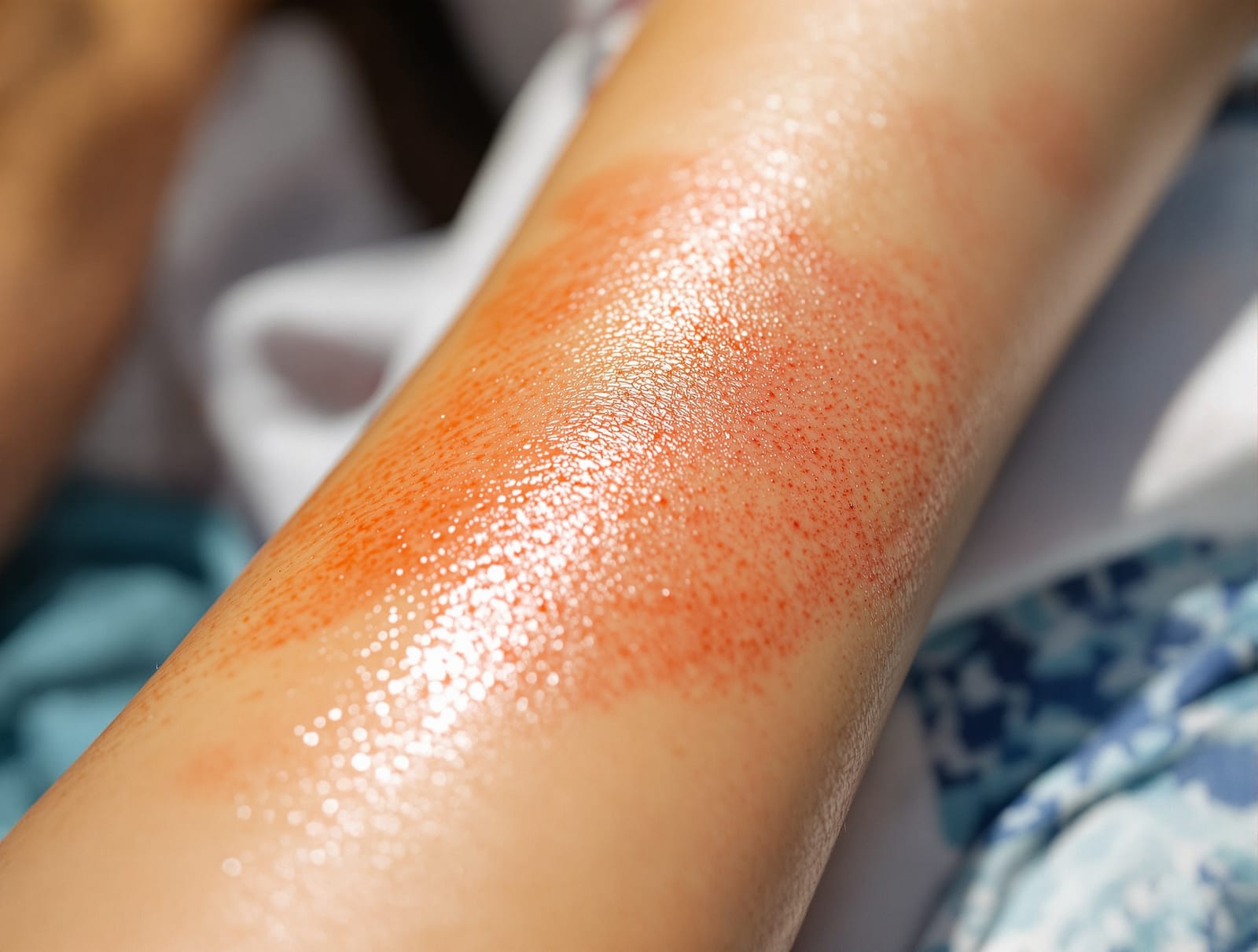
The original element in this piece is an ink-color reaction map paired with a tattoo-specific first-72-hours protocol: a single account of which pigment colors have the documented reaction history, why, and how the aftercare differs from ordinary sunburn care in four specific ways. Sunburn advice and tattoo aftercare advice both exist in abundance. Almost nobody writes the intersection, which is unfortunate, because that is where a large number of people find themselves every summer.
Start with where the ink actually lives, because everything follows from it. A tattoo is not on your skin. The needle deposits pigment into the dermis, below the epidermis, where immune cells engulf the particles and hold them more or less permanently in place. That depth is why tattoos are durable, and it is also why a sunburn interacts with them differently than you would expect. A sunburn is an ultraviolet injury concentrated in the epidermis and upper dermis, which is precisely the neighborhood the ink occupies.
Two consequences follow. First, tattooed skin is not protected skin. The visual density of a black tattoo creates a strong intuition that the ink is acting as a shield, and it does not, in any reliable way. Ultraviolet radiation reaches the living cells above and around the pigment perfectly well, and you will burn there as readily as anywhere else. Second, and less obvious, the pigment itself absorbs light energy, which is what makes some tattoos feel hot, raised, or itchy in strong sun even without a visible burn.
The color map. Reaction risk is not distributed evenly across a tattoo, and the pattern surprises people because it inverts the usual assumption.
Red is the highest-risk color, by a considerable margin. Red and its relatives, orange, pink, and the reds inside purple, have the longest and best-documented history of adverse reactions in the tattoo literature, including delayed hypersensitivity reactions that can appear months or years after the tattoo was placed. Reviews of tattoo complications repeatedly identify red pigment as the leading offender (Missouri Medicine, Arhiv za Higijenu Rada i Toksikologiju). These reactions can be provoked or worsened by sun exposure. If one section of a multicolored tattoo becomes raised, intensely itchy, or bumpy after a beach day while the rest is merely sore, look at whether that section is red.
Yellow historically carried a photosensitivity association, linked to cadmium-containing pigments in older inks. Modern formulations have largely moved on, so this is more relevant to older work than new work, but it is worth knowing if your tattoo is decades old.
Black is the lowest-reaction color and the hottest one. Black carbon-based pigment has the best allergic track record of any ink. It also absorbs the most light energy, which is why a large black piece can genuinely feel hot to the touch in direct sun. Heat is not a burn, but it is a signal you are absorbing energy, and it correlates with the exposure that will burn the skin around it.
Green and blue sit in between, with occasional documented reactions and no consistent pattern.
There is a further mechanism worth naming: laboratory work has shown that at least one common tattoo ink ingredient can generate phototoxic activity under ambient ultraviolet and sunlight exposure (Journal of Photochemistry and Photobiology B). That is a laboratory finding rather than a clinical one, and it should be read as a plausible mechanism rather than a proven clinical risk, but it is consistent with what dermatologists see.
The first 72 hours: four ways tattoo aftercare differs. Everything in our standard first-24-hours guidance still applies, cool water, hydration, bland moisturizer, no picking. These four things are additional.
One: cool, do not ice, and be stricter about it than usual. Ice on a healing sunburn is generally discouraged because it can deepen tissue injury. Over a tattoo there is an additional reason for caution: the barrier is already compromised and you are adding a second insult to skin holding foreign particles. Cool running water and cool compresses, never ice directly on skin.
Two: watch for the localized reaction, not just the burn. This is the tattoo-specific finding and the one to actually monitor for. General redness, warmth, and tenderness across the whole exposed area is sunburn. Redness, swelling, itching, or small raised bumps confined to one color within the tattoo, with the neighboring colors comparatively calm, is a pigment reaction, and it is a different problem with a different answer. The first resolves with time. The second is worth showing a dermatologist, particularly if it recurs each summer.
Three: the blister rule is stricter here. Ordinary sunburn blisters should be left intact. Over a tattoo, this matters more, because the roof of a blister is your only remaining barrier over dermis that contains pigment, and breaking it raises both infection risk and the chance of pigment loss during healing. If blisters form, leave them completely alone and cover loosely.
Four: expect the tattoo to look wrong for a while, and do not judge it early. As the burn heals, the epidermis over the tattoo peels. Peeling skin scatters light and makes the ink underneath look cloudy, faded, or milky. In most cases this resolves as the new epidermis matures over a few weeks. Do not book a touch-up, and above all do not have the area re-tattooed, until the skin has fully settled. Tattooing over recently burned skin is a genuinely bad idea.
The one real long-term cost. Sun exposure is the leading cause of tattoo fading, through ultraviolet degradation of the pigment particles themselves and through the immune activity that follows. Repeated burning accelerates this considerably. The people whose decade-old tattoos still look sharp are, with very few exceptions, the people who covered them.
What the studies do not tell you. Two honest gaps. First, there is no controlled research measuring sunburn severity on tattooed versus adjacent untattooed skin in the same person, so the widely repeated claim that tattooed skin burns worse is not established; what is established is that it does not burn less. Second, and more important for anyone assessing a mole, the tattoo complication literature is dominated by case reports and series rather than by prospective data, so incidence figures for pigment reactions do not really exist. What is well documented is which colors show up in those reports, which is what the map above is built from.
The part that is not cosmetic. Tattoo pigment obscures skin. A mole inside or beside a tattoo is harder to see, harder to photograph, and harder to track over time, and dermoscopy through ink is genuinely more difficult. Given that sunburn is a skin cancer risk factor, anyone with substantial tattooed area and a history of burns should be having their skin checked by someone who knows to look carefully at the edges. Never tattoo over an existing mole, and treat any change inside a tattoo, a new bump, a shift in texture, a spot that will not settle, as something to have examined rather than something the ink explains.
The practical summary: tattoos do not protect you, red is the color that reacts, protect with clothing or high-SPF broad-spectrum sunscreen once the skin is intact, leave blisters alone, and if one color misbehaves while the others do not, that is the finding worth taking to a dermatologist.