
Field Notes · July 28, 2026 · 8 min · By Zachariah Pohl
Altitude, snow and water: why the same UV index burns very differently
Two people can check the same forecast number and walk away with completely different burns, because the index describes what arrives from the sky and says nothing about what bounces back up at you. On snow, the reflected share can nearly double the dose reaching your face.
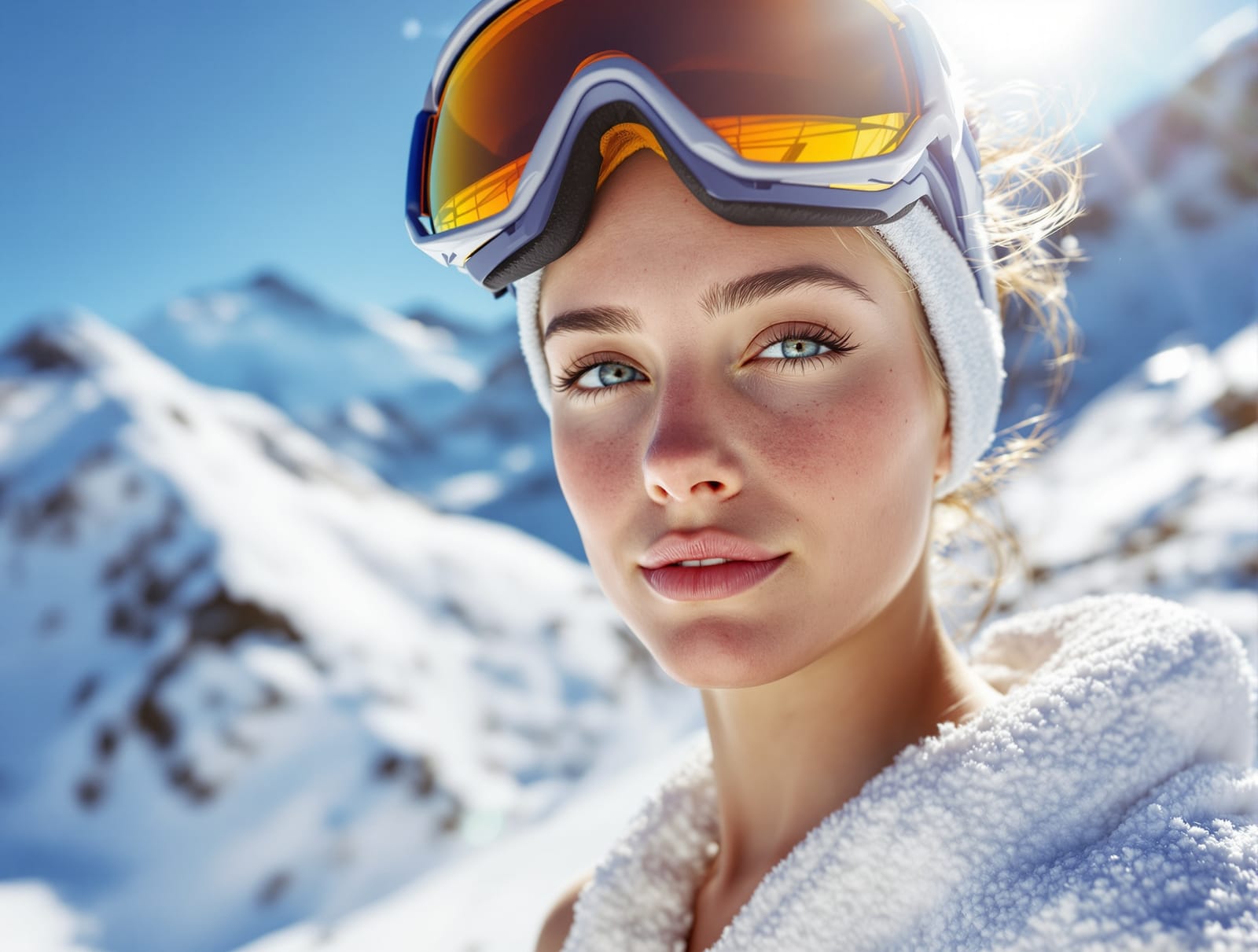
The classic version of this burn arrives at the end of a ski day and is concentrated in places that make no sense to the person wearing it. Under the chin. Inside the nostrils. The underside of the nose. The lower lip. The strip of neck below the jaw. People come home from a March weekend at altitude with a sunburn shaped like nothing they have ever had at a beach, and the usual explanation offered is that they forgot sunscreen, which is often not what happened.
What happened is that they applied sunscreen the way they apply it at sea level, to the surfaces facing the sky, and then spent six hours standing on a surface that reflects most of the ultraviolet radiation hitting it straight back up into everything facing down.
The original element in this piece is a reflected dose estimate you can do in your head before you go out, built by combining the published altitude increment with the published surface reflectance figures into a single rough multiplier, with the method and its limits stated openly so you can see exactly how much confidence it deserves. The two component figures are well established and separately published. Nobody combines them into something a person can use while packing, which is the gap this fills.
Where the forecast number comes from and what it leaves out. The UV index is a measure of the erythemally weighted ultraviolet irradiance expected at ground level, and both the WHO fact sheet on ultraviolet radiation and the EPA scale describe it as a forecast of the intensity arriving at the surface. It is calculated for a horizontal surface facing up. That is the correct convention and it is why the number is comparable between cities.
It is also why the number under describes what happens to a three dimensional object standing on a reflective surface. Your face is not a horizontal plane facing the sky. Half of it faces sideways and a meaningful portion faces downward, and the downward facing portion receives essentially nothing at a beach and a great deal on a glacier.
The two published figures. First, altitude. Ultraviolet intensity increases with elevation because there is less atmosphere above you to scatter and absorb it, and the WHO figure in general circulation is an increase on the order of ten to twelve percent for every thousand meters of elevation gained. Second, surface reflectance. Fresh snow reflects up to roughly eighty percent of incident ultraviolet. Sea foam is often cited near twenty five percent, dry beach sand around fifteen percent, open water around ten percent for typical geometry, and grass, soil and most urban surfaces low single digits.
Doing the arithmetic. Take the forecast index for the location. Multiply by roughly one point one for each thousand meters of elevation above the forecast point, which for a resort at three thousand meters against a valley forecast is a factor of about one point three. Then add the reflected share for the surface you will be standing on, applied to the parts of you facing it.
A forecast index of six in a mountain valley, at a resort three thousand meters higher, on fresh snow, comes out near eight before reflection. With snow returning up to eighty percent of that from below, the total exposure reaching a face that is receiving both direct and reflected light approaches double the number on the app. On open water the same arithmetic is far less dramatic, roughly a ten percent addition, which is why the classic boating burn is a top of the shoulders and bridge of the nose burn rather than an under the chin one.
What this changes practically. It reorders where the sunscreen goes. At altitude on snow, the underside of the nose, the underside of the chin and jaw, the front of the neck, the ears including the lower rim, and the lips get the same attention as the forehead and cheeks, because they are the surfaces facing the reflector. Lips are the most commonly missed and among the most miserable to burn, which the guidance on sunburn on the lips, eyes and scalp covers in more detail. Eye protection stops being optional, because the same reflected dose that burns the underside of your chin also reaches the cornea, and photokeratitis from snow is a well described injury.
It also changes reapplication logic. On snow, sweat and glove contact remove product from exactly the high exposure areas, and the reflected component does not diminish in late afternoon the way direct overhead intensity does, because the sun angle that reduces direct dose simultaneously increases the path across a reflective surface. The choice between mineral and chemical formulations matters less here than the choice to reapply at all.
Why this population is a documented risk group. This is not a theoretical concern. The literature on outdoor sports and skin cancer identifies high altitude and snow sport participants as a group with elevated cumulative ultraviolet exposure, and dedicated screening and outreach work such as the skin cancer screening program at Utah ski resorts exists because the exposure pattern in this group is different enough from the general population to warrant its own intervention.
What the studies do not tell you, stated plainly. The two figures used above come from different kinds of measurement and were never intended to be multiplied together. The altitude increment is an average across latitudes, seasons and atmospheric conditions, and the real value at any given site and hour varies substantially with cloud, ozone and aerosols. The reflectance figures are for idealized surfaces, and fresh snow reflects far more than the packed, dirty, late season snow most people actually ski on, which can fall to half the headline number or lower. There is also no clean way to say what fraction of your face is oriented toward the reflector, since it changes every time you move your head.
So this is an estimate for deciding how careful to be, not a dosimetry calculation. Treated that way it is still far more useful than the raw index, because the raw index systematically understates the exposure in exactly the settings where people get their worst burns. If one does get through, the standard sequence in the first twenty four hours applies without modification, and reading the index itself correctly is the input the whole calculation depends on.
The takeaway is that the number on your phone is a ceiling for a flat surface facing the sky and a floor for a face standing on snow.